
The Death Railway, Kanchanaburi, Thailand: An Experience Worth Remembering
When we think of Thailand, images of turquoise waters, tropical islands, vibrant street markets, and the energy of Bangkok usually come to mind. Rarely do we associate the country with stories from World War II, or with one of the most haunting chapters of modern history. In fact, growing up, I don’t remember Thailand ever featuring much in our history lessons.
But on my last trip to Thailand, I discovered a side of the country I had never expected.
A short day trip from Bangkok led me to Kanchanaburi, home to the Death Railway, also known as the infamous Thailand–Burma Railway. What began as a simple excursion turned into one of the most moving and unforgettable experiences of my travels. Behind the beautiful landscapes and peaceful river views lies a history of unimaginable human suffering, resilience, and survival, one that deserves to be remembered.
A couple of trips to Thailand, and every journey has shown me a different side of the country. I’ve wandered along the beaches of Krabi, explored the creative corners of Chiang Mai’s artist village, and walked through the postcard-perfect lanes of Song Wat and Talat Noi in Bangkok.
But it was while watching Travels with My Father on Netflix that I first came across Thailand’s Death Railway, and I was genuinely surprised I had never heard of it before.
As Jack Whitehall and his father took a day trip from Bangkok to Kanchanaburi to visit the famous Bridge on the River Kwai, my curiosity grew. I found myself reading more about the place, falling deeper into its history, and eventually adding it to my travel notes with one clear intention: someday, I had to see it for myself.
On my most recent trip to Thailand, I finally did!
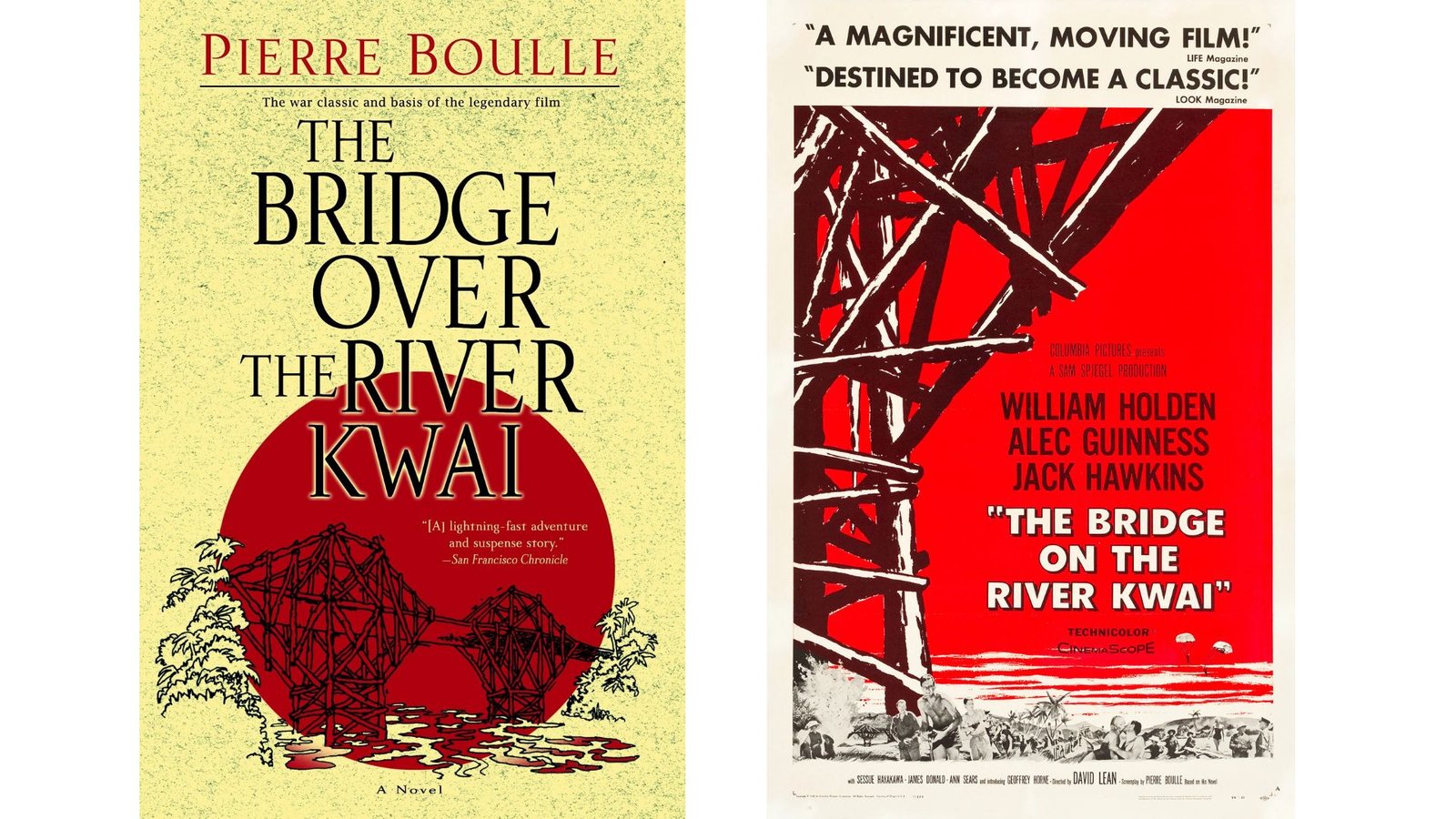
I explored both the Death Railway and Hellfire Pass, witnessing firsthand a landscape that today appears peaceful, yet carries memories of immense suffering. The history of the railway later inspired Pierre Boulle’s novel The Bridge on the River Kwai, which was adapted into David Lean’s acclaimed 1957 war film.
The History of the Death Railway of Kanchanaburi
The story of the Death Railway begins during the darkest years of World War II.
Between October 1942 and October 1943, Imperial Japan undertook one of the most ambitious and devastating infrastructure projects of the war: the construction of a railway connecting Thailand and Burma (now Myanmar). Officially called the Burma–Siam Railway, the line stretched approximately 415 kilometers from Ban Pong in Thailand to Thanbyuzayat in Burma.
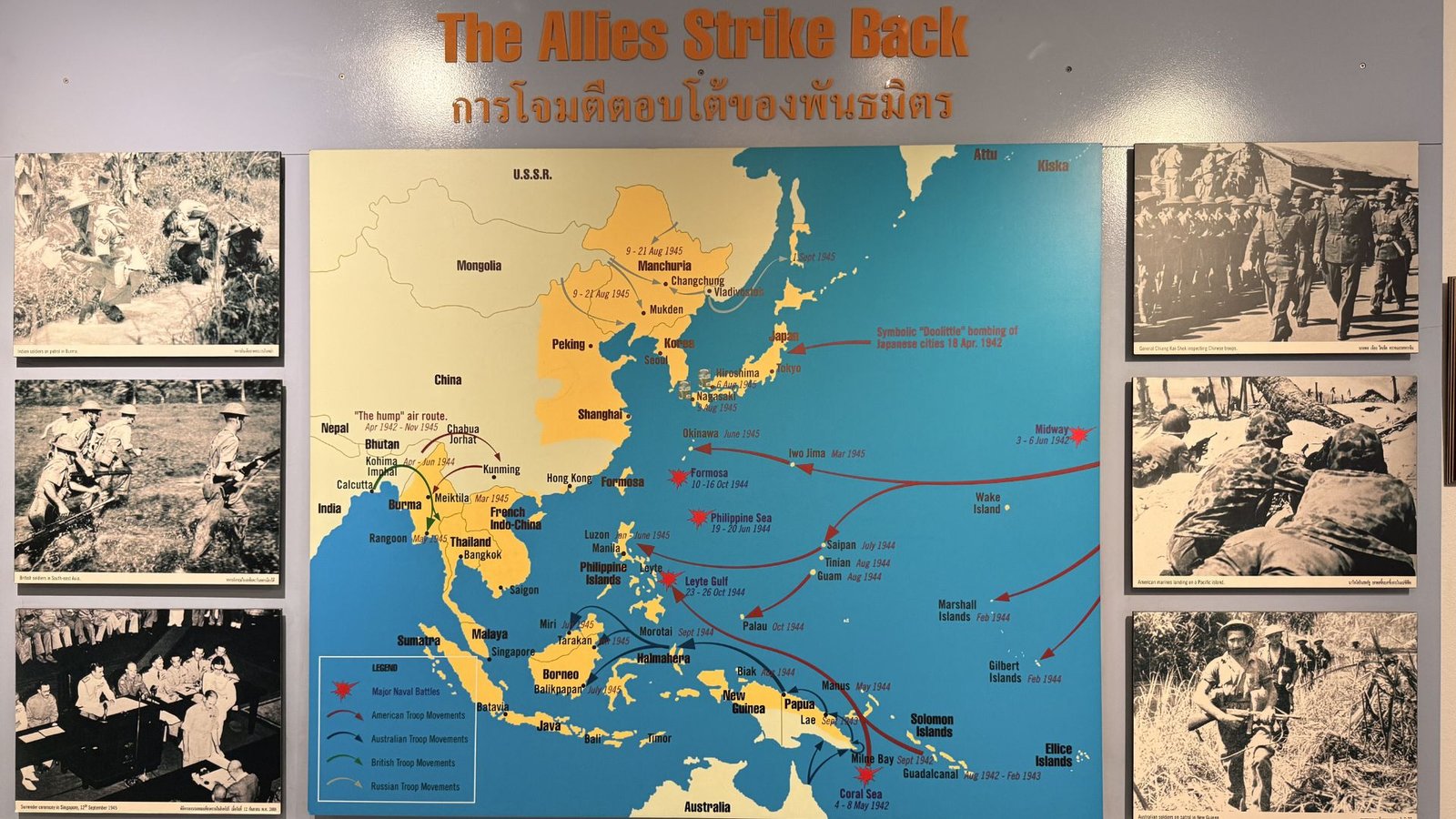
At the time, Japan controlled large parts of Southeast Asia and needed a reliable supply route to support military operations in Burma. Sea routes had become increasingly vulnerable to Allied attacks, making an overland railway strategically important. Building such a route through dense jungles, steep mountains, and unforgiving terrain would normally have taken years. Instead, it was completed in just over a year, and that speed of work came at an unimaginable human cost.
To build the railway, Japanese forces relied heavily on forced labor. Around 60,000 Allied prisoners of war (POWs), including soldiers from Britain, Australia, the Netherlands, and the United States, were brought in alongside an estimated 180,000 to 250,000 Asian civilian laborers, many of whom came from present-day Myanmar, Malaya, Indonesia, Thailand, and surrounding regions.
These laborers became known collectively as romusha, and their conditions were brutal.
Workers endured extreme heat, relentless monsoon rains, dense jungle environments, and impossible construction schedules. They worked long hours with minimal tools, inadequate food, and little medical support. Diseases such as cholera, malaria, dysentery, and beriberi spread rapidly through overcrowded camps.
Physical exhaustion was compounded by punishment and violence. As construction deadlines intensified, a period remembered as the “Speedo” phase pushed workers beyond human limits, forcing them to work day and night to complete sections of the railway.
The result was catastrophic.
It is estimated that more than 12,000 Allied prisoners of war lost their lives during construction, along with approximately 90,000 Asian laborers, although many historians believe the actual civilian death toll may have been even higher due to incomplete records.
These staggering losses earned the route its enduring name: The Death Railway.
One of the most difficult sections of the railway was Hellfire Pass, where workers carved directly through solid rock using basic hand tools. At night, the area was illuminated by torchlight, creating a scene witnesses later described as resembling the fires of hell, giving the pass its haunting name.
Today, parts of the railway remain operational and can still be travelled by train. Visitors can walk through Hellfire Pass, stand on the historic Bridge on the River Kwai, and visit museums and memorials that preserve the memories of those who suffered here.
What makes a visit to Kanchanaburi unforgettable isn’t just the history itself; it’s the contrast that one gets to witness at this place.
The landscapes are serene. The river flows quietly. Trains still pass through the same tracks. And yet, beneath that calm lies a powerful reminder of human endurance, loss, and the importance of remembering stories that history books often leave behind.
A Day Trip to Kanchanaburi from Bangkok to Witness The Death Railway and The Hellfire Pass
To experience this chapter of history firsthand in Thailand, I booked a day trip from Bangkok to Kanchanaburi. The itinerary promised a deep dive into the story of the Death Railway, with visits to the Kanchanaburi War Cemetery, the Death Railway Museum, a train ride across the iconic Bridge on the River Kwai, and finally, a walk through the haunting Hellfire Pass.
Our day began early. At 5:30 in the morning, we left Bangkok while the city was only beginning to wake up. Kanchanaburi lies approximately 125 kilometers west of Bangkok, and the drive took us around two and a half hours, passing through quiet suburbs, open stretches of countryside, and eventually greener landscapes. It was difficult to imagine that such peaceful surroundings had once witnessed one of the most tragic wartime projects in history.
Our guide, Luke, told us brief stories from the past and how the Second World War impacted the people of Thailand. While he quite proudly spoke about the fact that Thailand was the only Southeast Asian country that was never colonised, he couldn’t deny the fact that the tragedies of war left deeper wounds in the hearts of the people.
Kanchanaburi War Cemetery: A Place of Silence and Remembrance
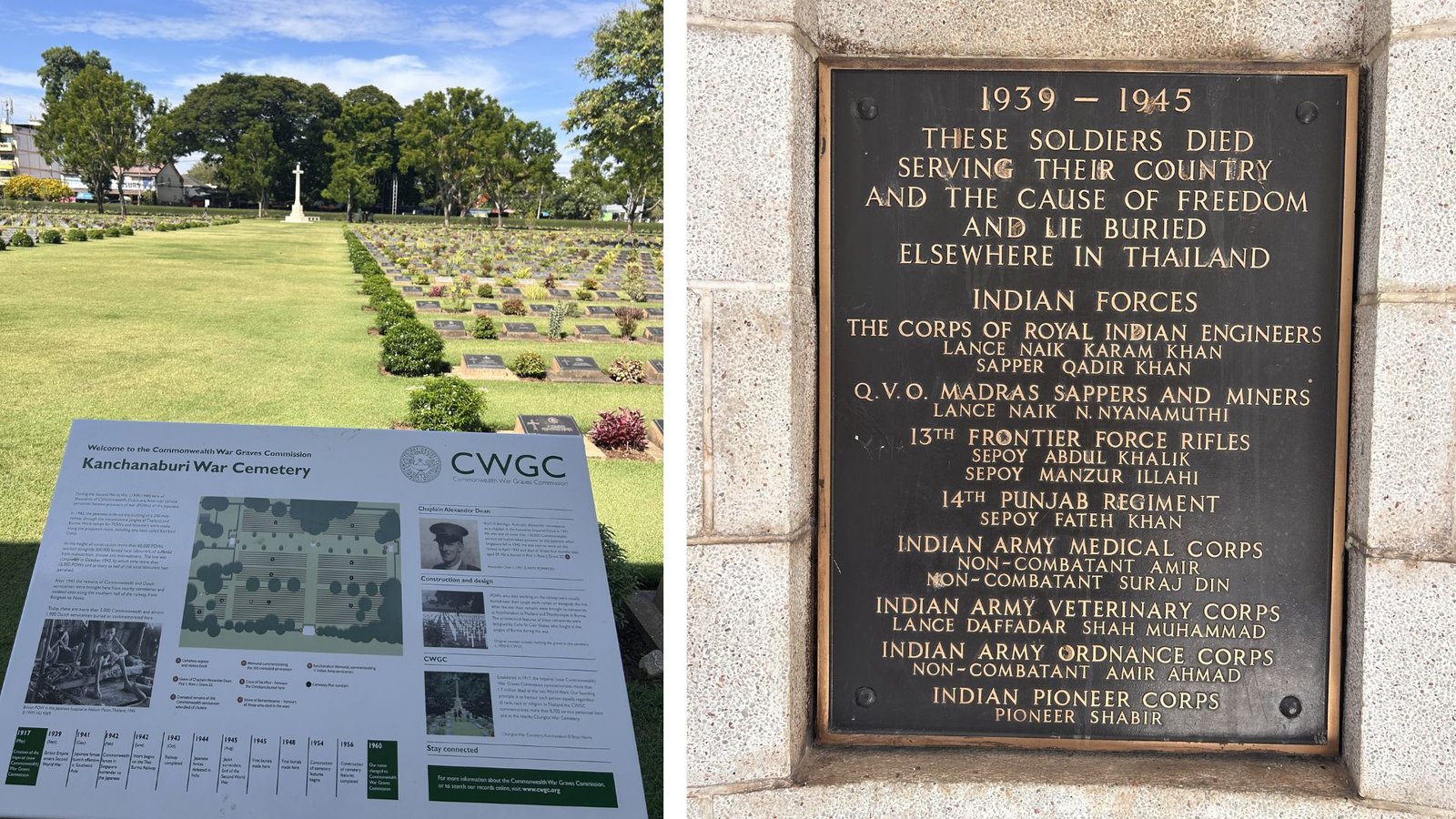
Our first stop was the Kanchanaburi War Cemetery, and somehow it reminded me of some of the other war cemeteries I’ve visited before – beautifully maintained, incredibly peaceful, and yet carrying stories that are impossible to fully imagine.
Rows of identical headstones stretched across neatly kept lawns, each one marking the life of an Allied POW who died during the construction of the Burma–Siam Railway. Walking through them slowly, I noticed names from different countries and realised how young so many of them were! Men who had travelled thousands of kilometres from home and never made it back.
Some graves carried short messages left by families, while others simply had a name and an age. And somehow, those felt even harder to read.
One thing that particularly stayed with me was noticing the memorials dedicated to Indian soldiers as well. Many Indian soldiers had served during World War II in this region, and some lost their lives in Thailand. Standing there and seeing Indian names in a place like Kanchanaburi made the history feel unexpectedly close to home. It was one of those moments during travel that quietly reminds you how interconnected our histories really are.
The Death Railway Museum of Kanchanaburi
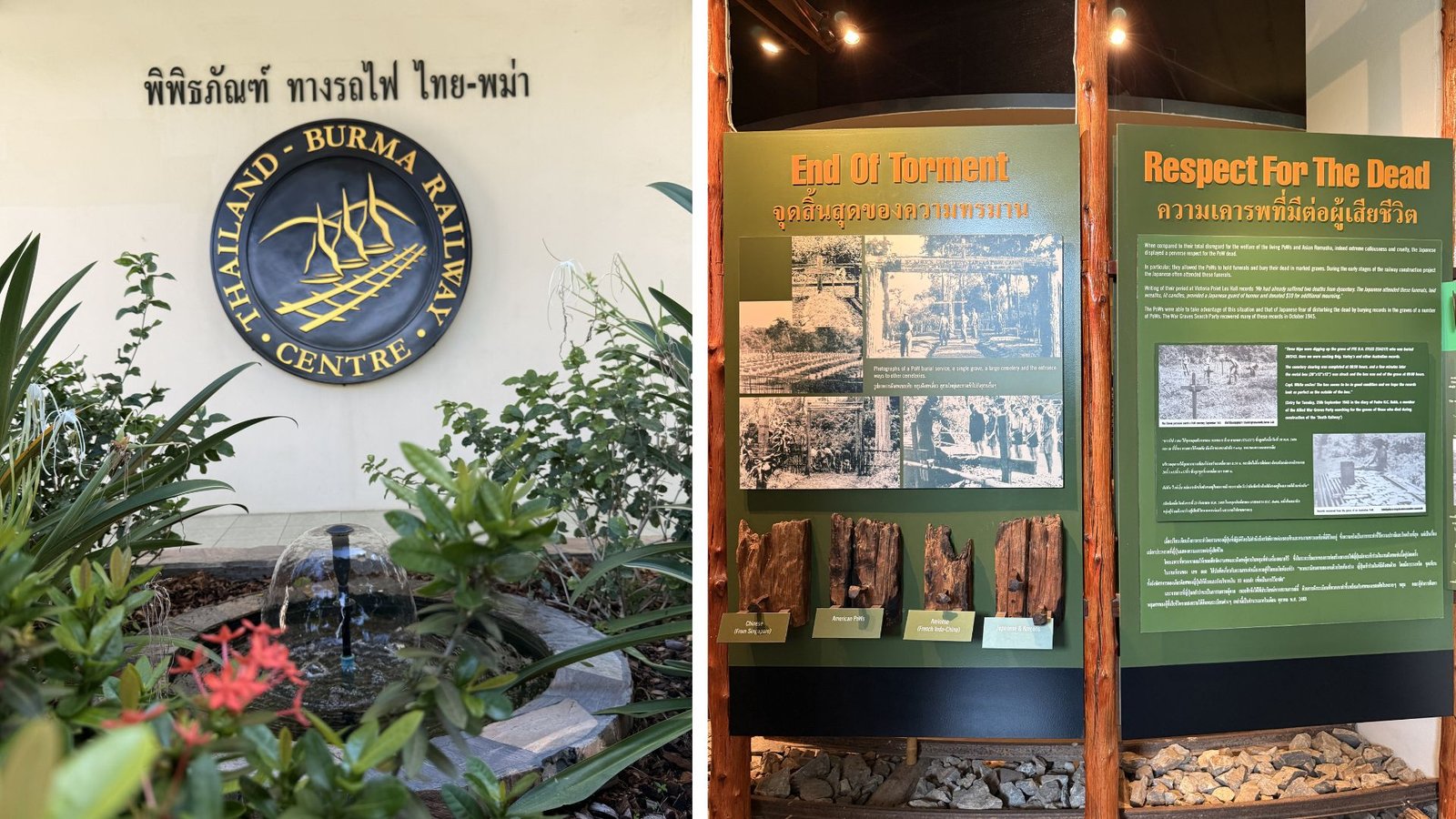
Just across the road from the cemetery is the Thailand–Burma Railway Centre, more commonly known as the Death Railway Museum.
If you’re expecting a large museum with dramatic exhibits and fancy installations, this isn’t that. In fact, the museum is fairly simple and modest, more like stepping into an archive or a library that exists to preserve stories rather than impress visitors. At the entrance, there was a sign requesting everyone to maintain silence and pay respect, and somehow that immediately changed the mood.
As we walked in, the first thing we noticed was the music inside this building. Every now and then, the sound of trains passing nearby echoed through the building. It felt strangely moving because the railway still exists today, and that distant chugging became a quiet reminder that this history isn’t as distant as it seems.
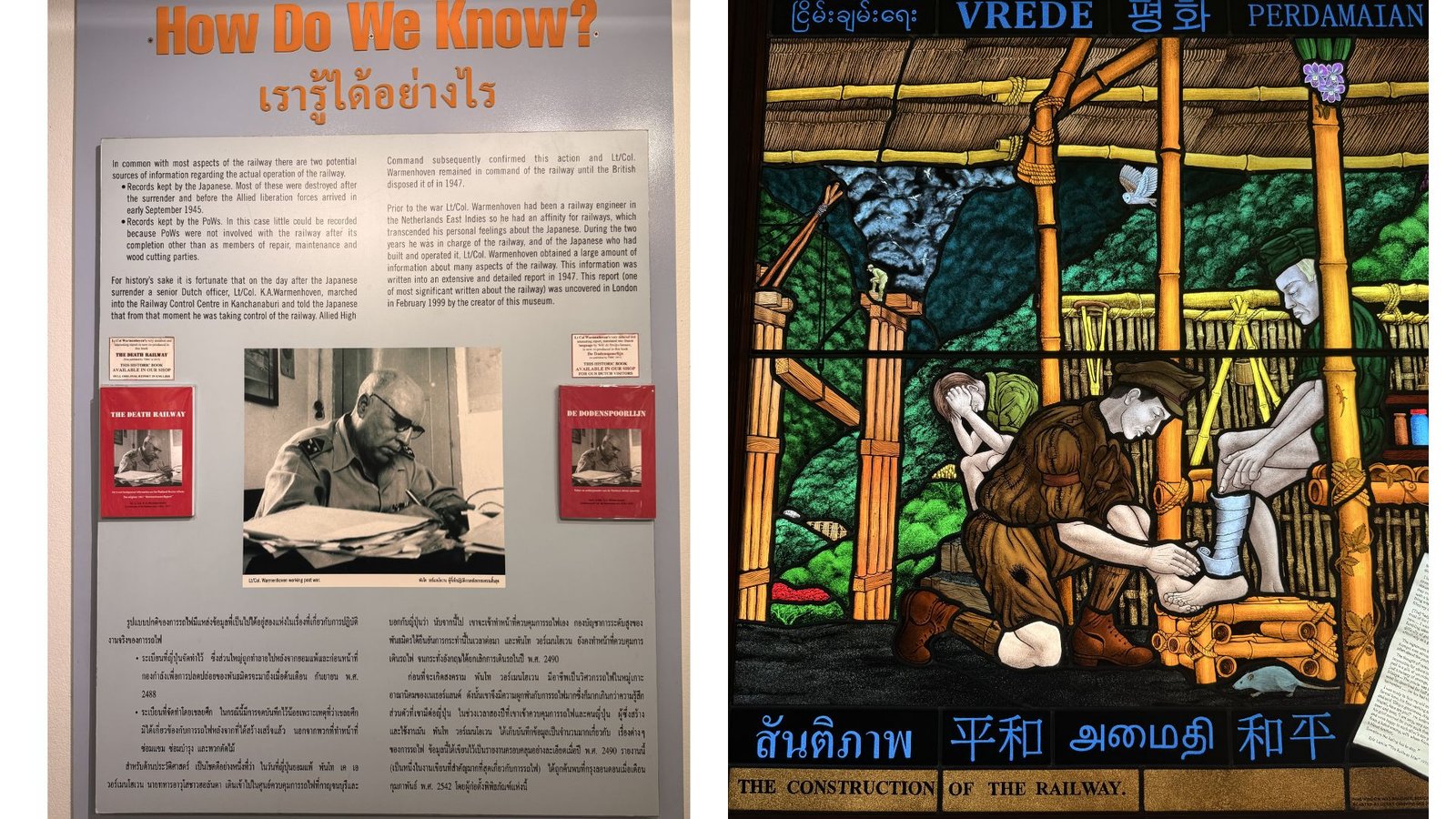
And then, there were stories of the people. As we moved through the exhibits, the photographs, records, and video clips slowly started putting faces to a story that otherwise feels too large to imagine. The museum documents the lives of Allied prisoners of war and Asian laborers, who were forced to build the railway under extremely harsh conditions.
There are archives which show how the diseases spread rapidly through the camps, and with little food, poor sanitation, and almost no medical support. Cholera, malaria, dysentery, severe malnutrition, and complete physical exhaustion became a part of everyday life. As construction accelerated and deadlines became harsher, the conditions only continued to deteriorate.
One section that really got to me displayed personal belongings and letters.
Some of the prisoners had written home. Some letters never reached anyone. There were notes written on scraps of paper, toilet paper, and even leaves. People improvised with whatever they had. They used strands of hair to make brushes and pens. There were simple tins and vessels, small everyday objects, and faded photographs of loved ones carried from home.
Another part of the museum talked about how the workers tried to keep themselves going emotionally. Before construction entered what was called the ‘Speedo’ period, when work intensified to complete the railway faster, prisoners found small ways to survive mentally. They sang, danced, performed for each other, and created support groups among themselves. Because even in conditions that seem impossible to imagine now, people still found ways to hold on to hope, friendship, and some sense of normal life.
The Death Railway Museum focuses less on the engineering and construction of the railway and more on the lives of the people who built it. Their stories, struggles, and the small pieces of humanity they held on to in impossible conditions are what stay with you long after the visit.
And perhaps, that is what makes this place so significant.
A Train Ride Crossing the Bridge on the River Kwai
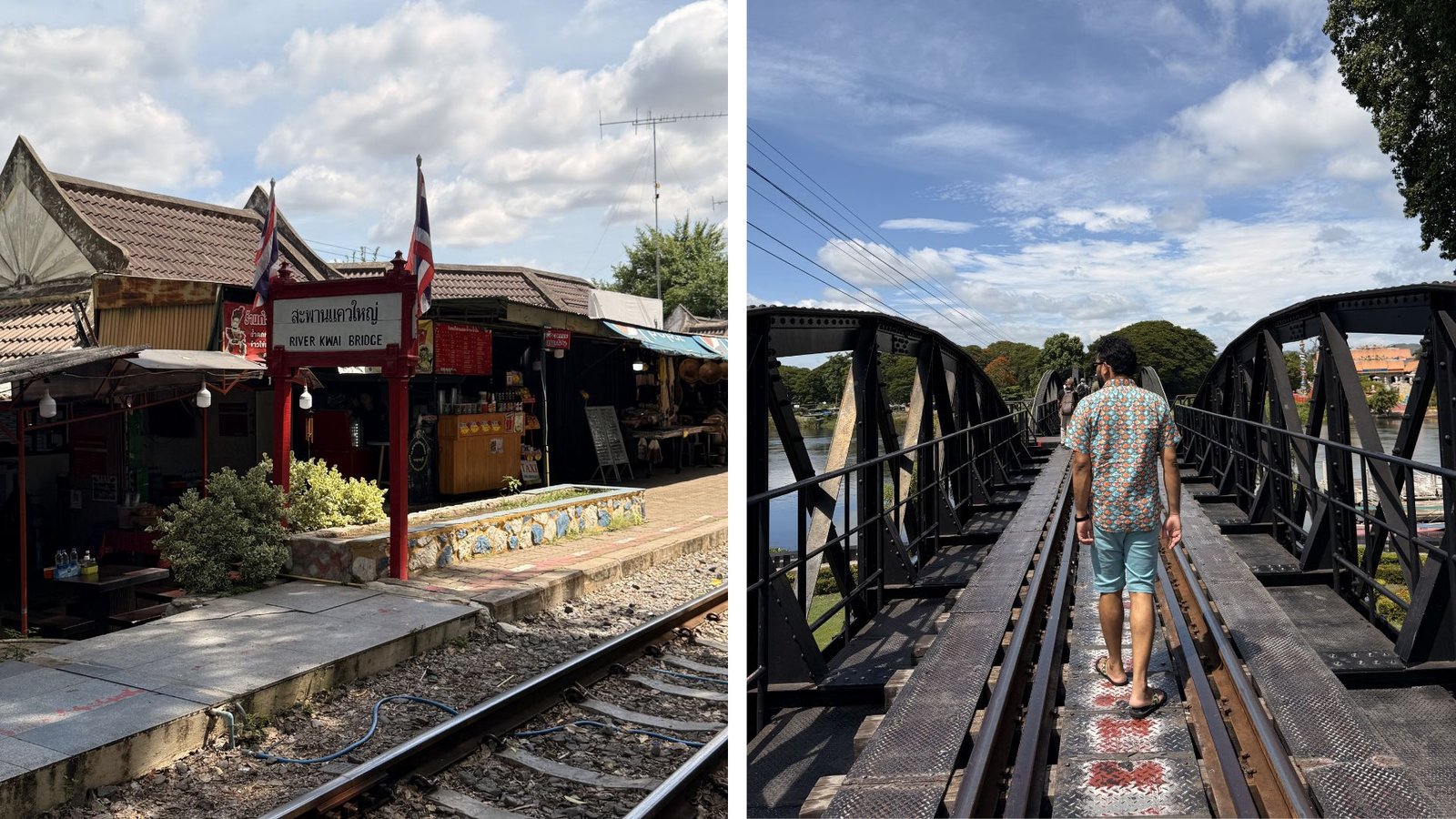
As we got back into our car after visiting the museum, Luke told us that our next stop would be Kanchanaburi Railway Station, from where we would board the train and cross the famous Bridge on the River Kwai.
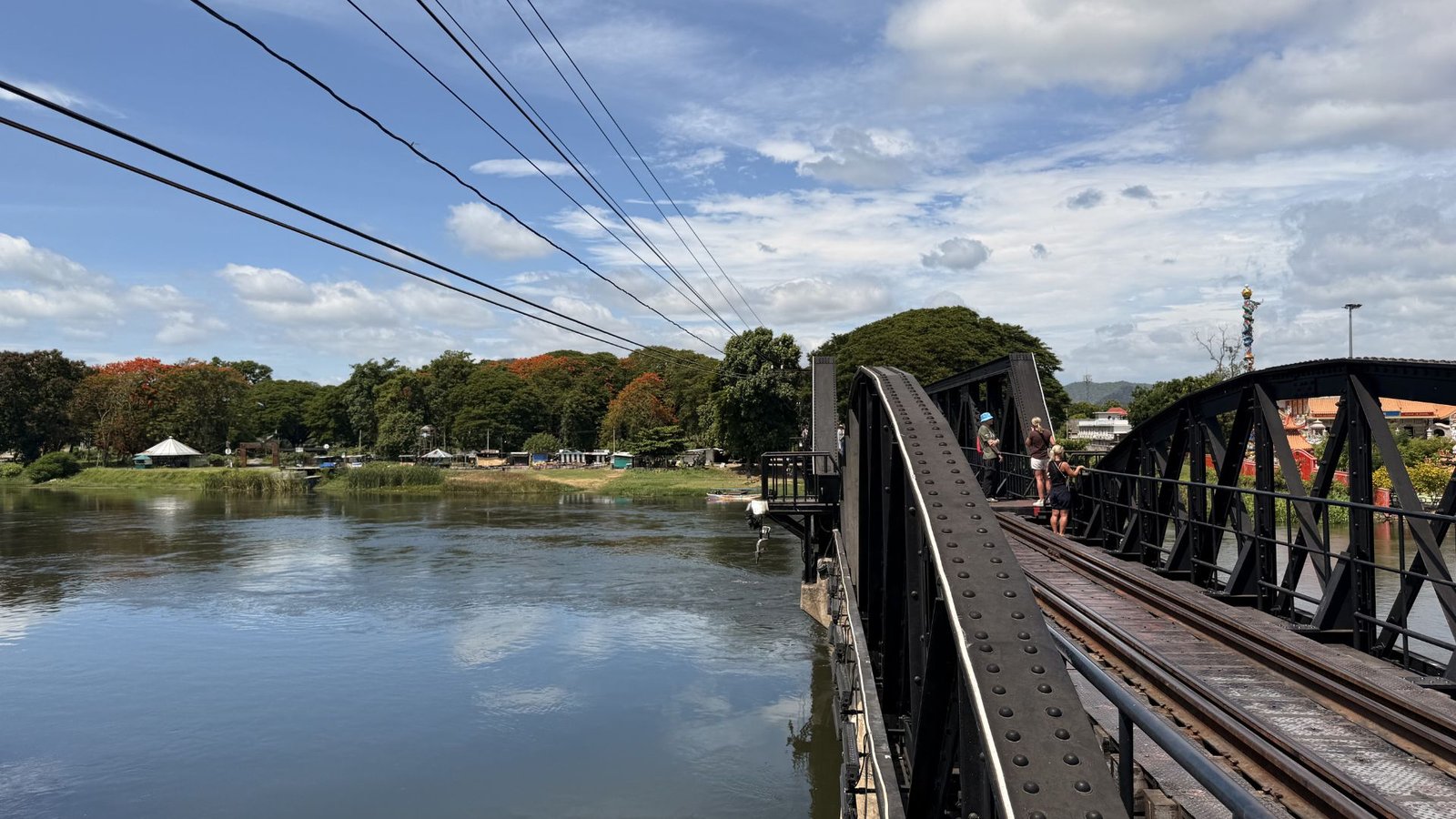
On the way, he also explained something I hadn’t known before. The river that the bridge stands over is actually the Khwae Yai River, and nearby, the Khwae Yai and Khwae Noi rivers meet to form the Mae Klong River. It was interesting because the name “River Kwai” is so famous globally through books and films, but standing there, you realise there’s more to the story than what popular culture tells us!
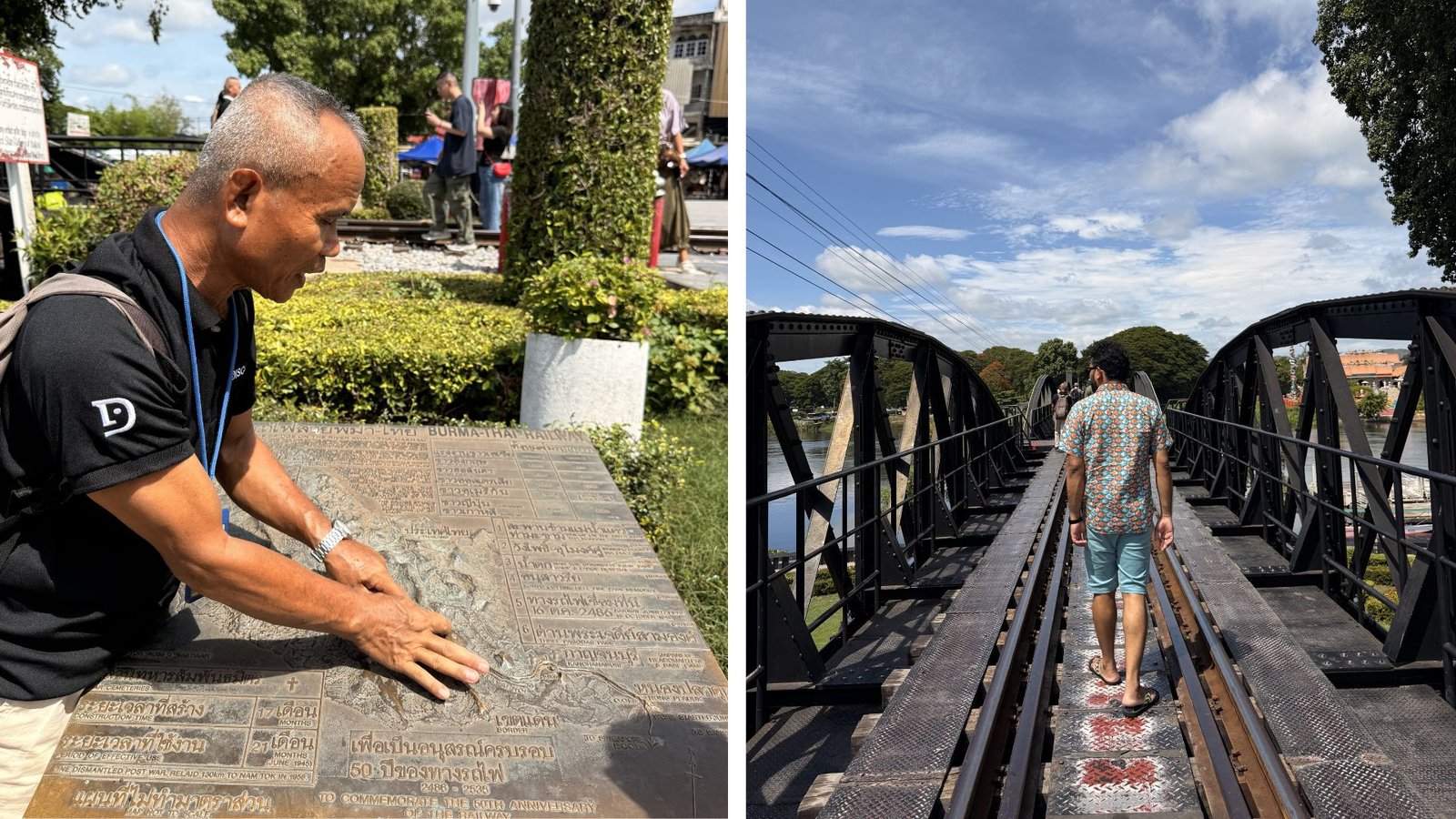
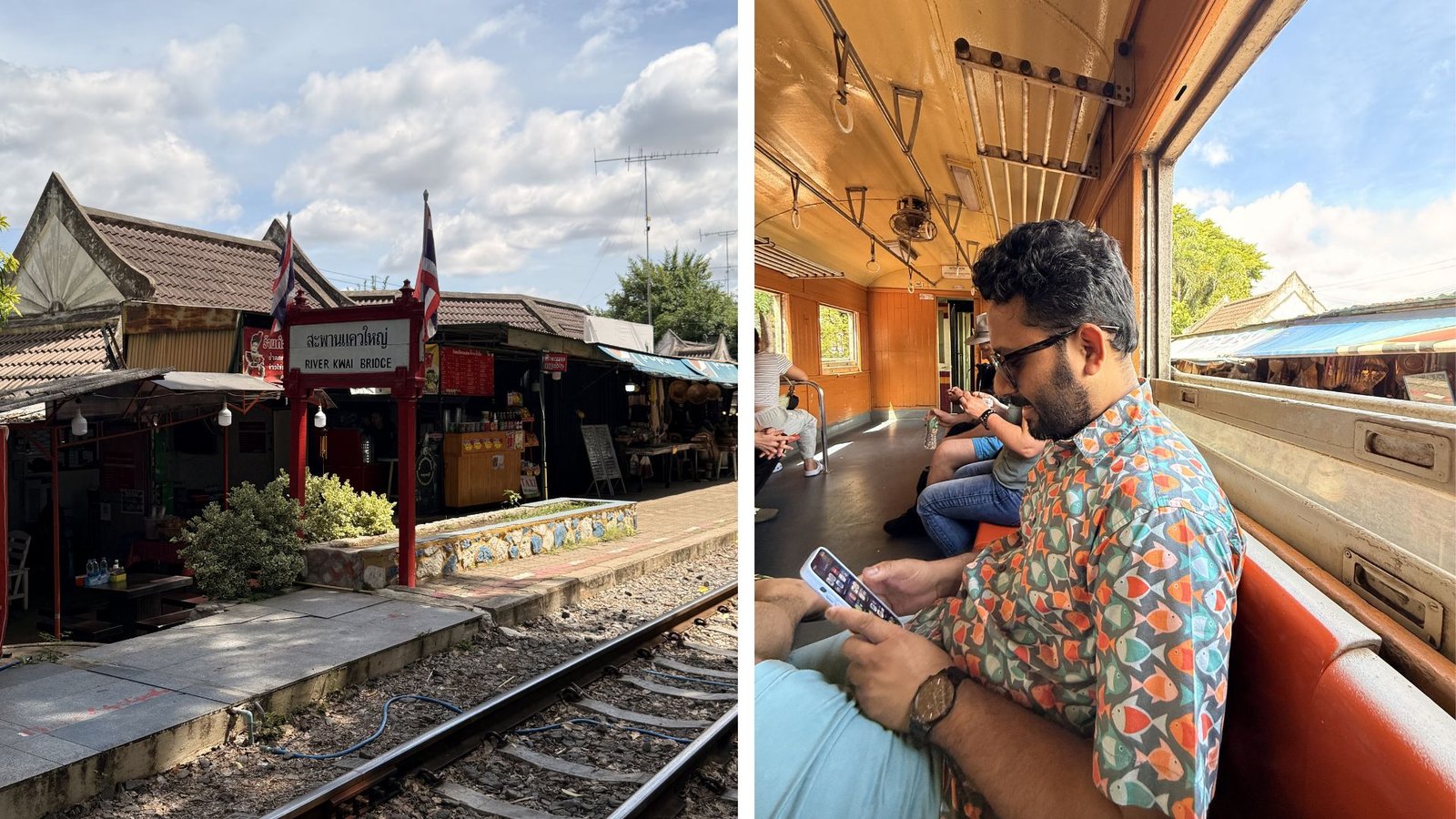
There’s something about train journeys that I’ve always enjoyed, so I had been looking forward to this part of the day. But this wasn’t going to be just another scenic train ride. These tracks carry stories of unimaginable hardship and stand as a reminder of one of the darkest chapters of World War II.
At around 10:40 am, the train slowly rolled into the station, and we got on.
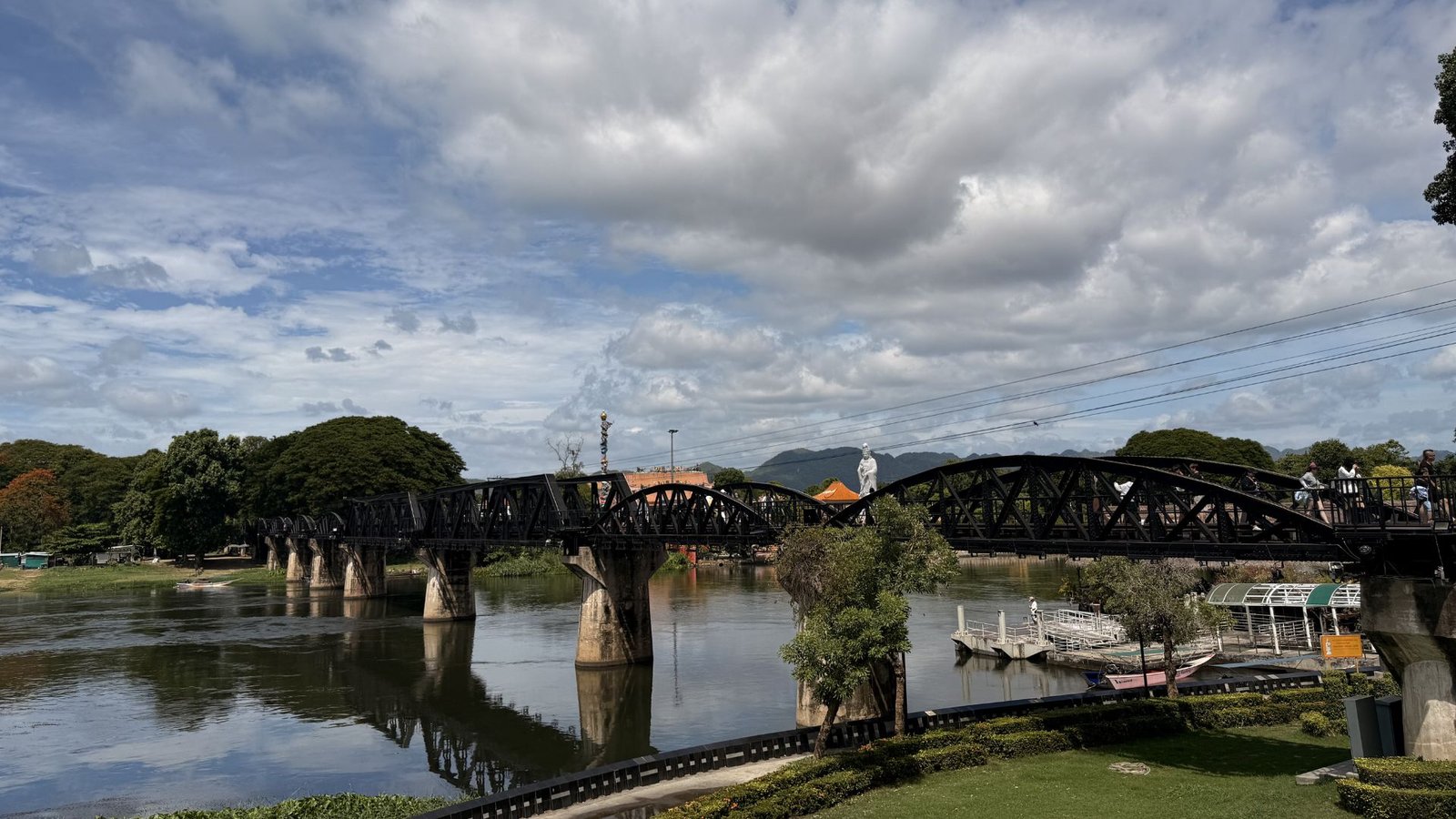
Today, only a surviving section of the original Death Railway remains operational, and trains run up to Nam Tok station. The stretch between Kanchanaburi and Nam Tok is around 77 kilometres, passing through some of the most scenic landscapes in the province.
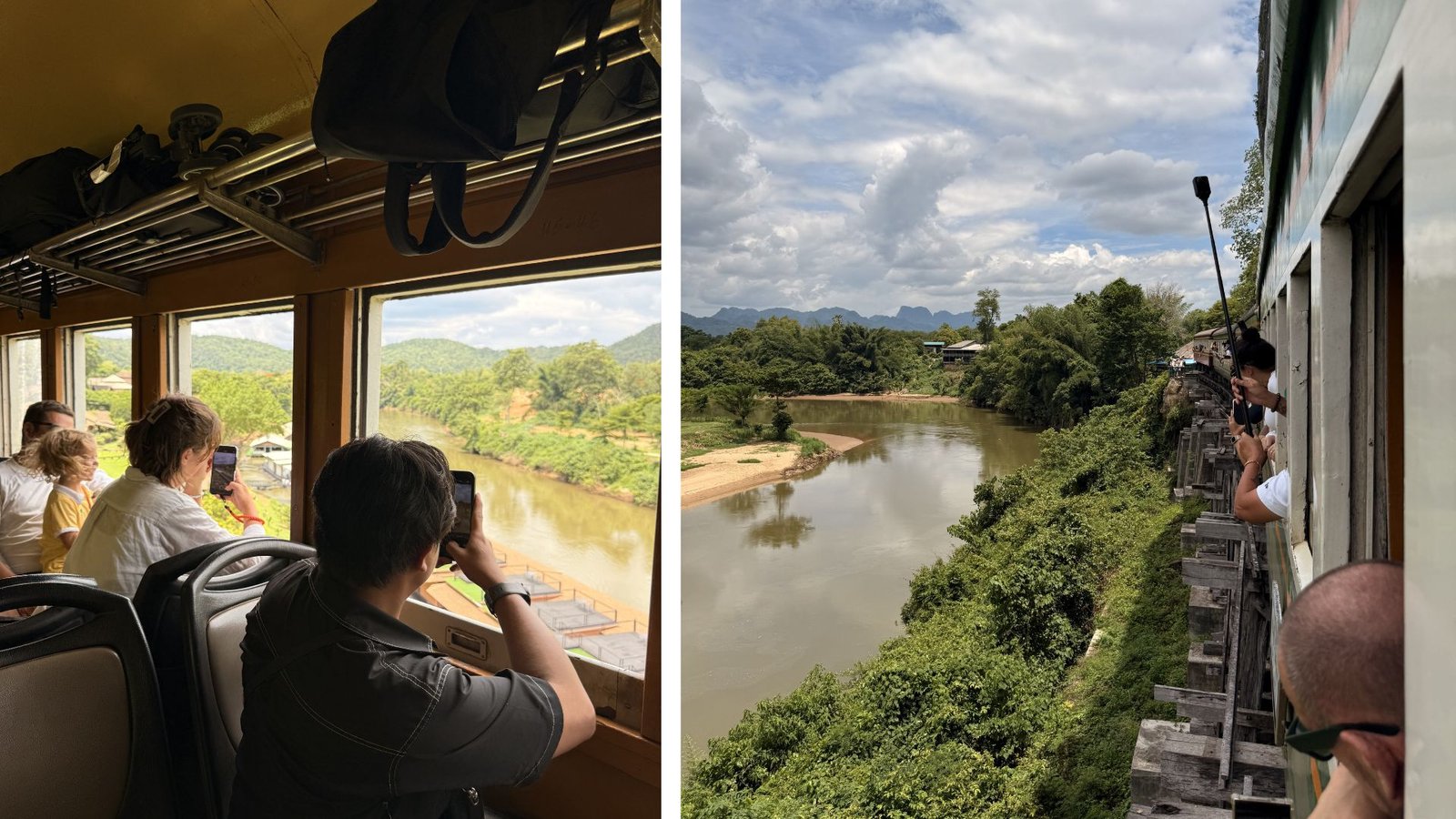
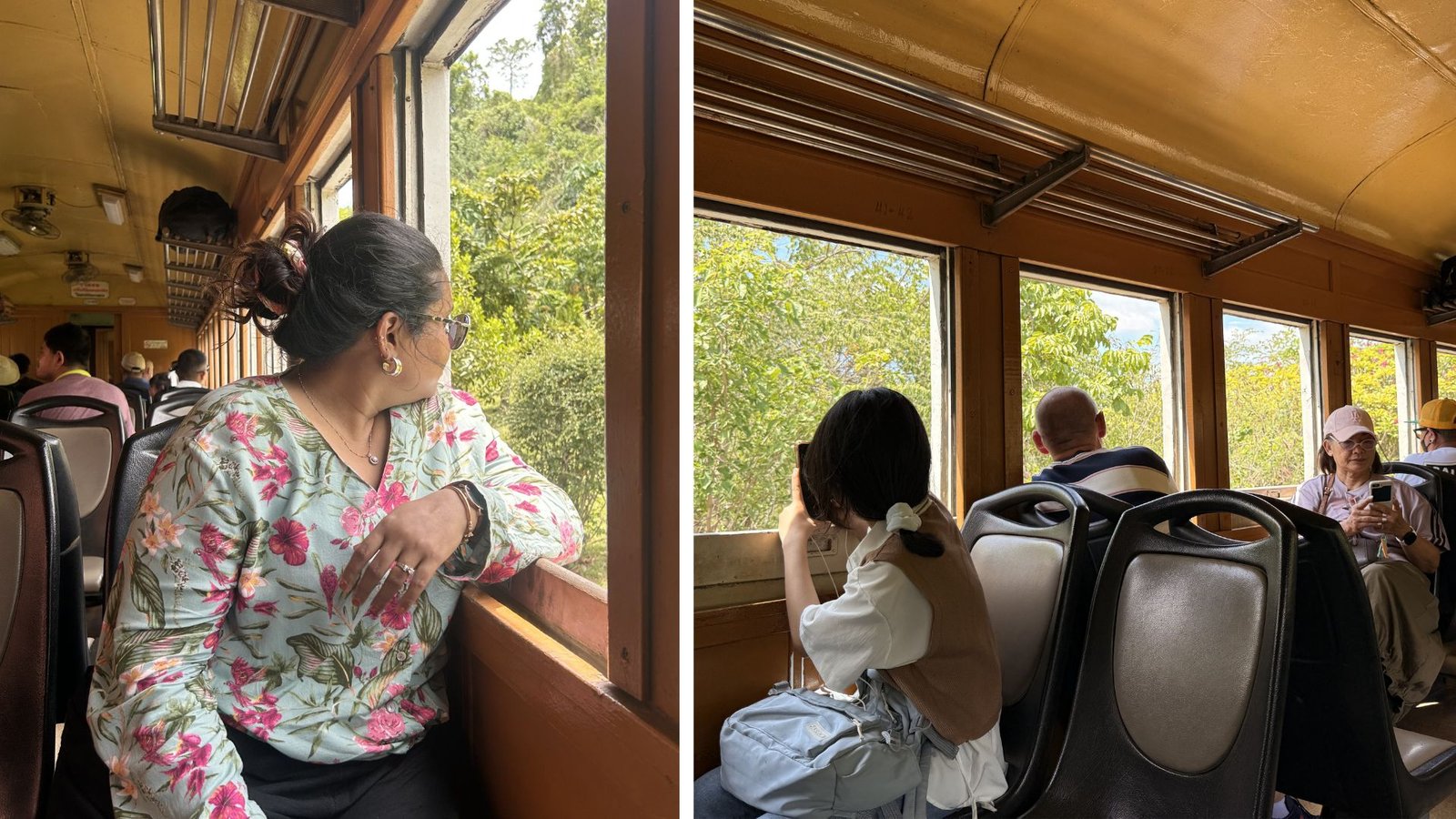
Soon after departure, we crossed the famous bridge. People leaned out with cameras, trying to capture the moment, while I found myself looking down at the river below and thinking about everything I had just seen in the museum.
After crossing the bridge, the train continued along the Khwae Noi River, winding through farmlands, small villages, patches of forest, rocky hills, and open landscapes. At moments, the tracks felt impossibly close to the edge, especially around the wooden sections that cling dramatically to the cliffs.
It was beautiful, like a usual slow countryside rail ride. The views outside were peaceful, green, and almost postcard-perfect. At times, villages waved at us when they saw the train passing by! Honestly, if I didn’t know the history, it would have felt like one of Thailand’s most scenic train rides. But once you know what these tracks represent, the journey feels different.
Hiking Through Hellfire Pass
Once we got off the train, Luke took us to a nearby restaurant for lunch. After spending the morning moving between memorials, museums, and stories from the war, it felt nice to pause for a bit. The lunch was simple and comforting. Thai curry with rice, eaten slowly while chatting and processing everything we had seen so far.
After lunch, we drove for about 25 minutes to reach Hellfire Pass, and on the way, Luke shared stories about the pass.
“Hellfire Pass was one of the most difficult sections of the railway to construct. Workers had to manually cut through solid rock with basic tools, and this stretch became known for the immense human suffering associated with its construction. Many labourers and prisoners of war lost their lives here,” Luke mentioned.
Listening to him, I knew that the name itself comes from the scenes witnessed during construction. Before starting the trail, Luke pointed towards the hills visible in the distance and told us that beyond them lay Myanmar.
Today, there is no active railway line here. Instead, the site has been preserved as a memorial, supported in part by the Australian government, along with the Hellfire Pass Memorial Museum, which gives context before beginning the walk.
From the visitor centre, a trail leads down through bamboo forests and quiet slopes towards the memorial site.
Like most visitors, we picked up the audio guide before starting the walk, and I would really recommend doing that. It isn’t just information. As you walk, voices and stories from survivors play in your ears, describing daily life, the work conditions, and memories of the place. Somehow, it makes the landscape around you feel different.
The most famous section here is ‘Konyu Cutting’, a deep rock cutting that became symbolic of the suffering associated with the railway. Construction often continued late into the night under torchlight. Survivors later described seeing silhouettes of exhausted workers moving inside the illuminated rock face, creating a scene that looked like fire rising out of the earth. That image gave this place its haunting name: Hellfire Pass.
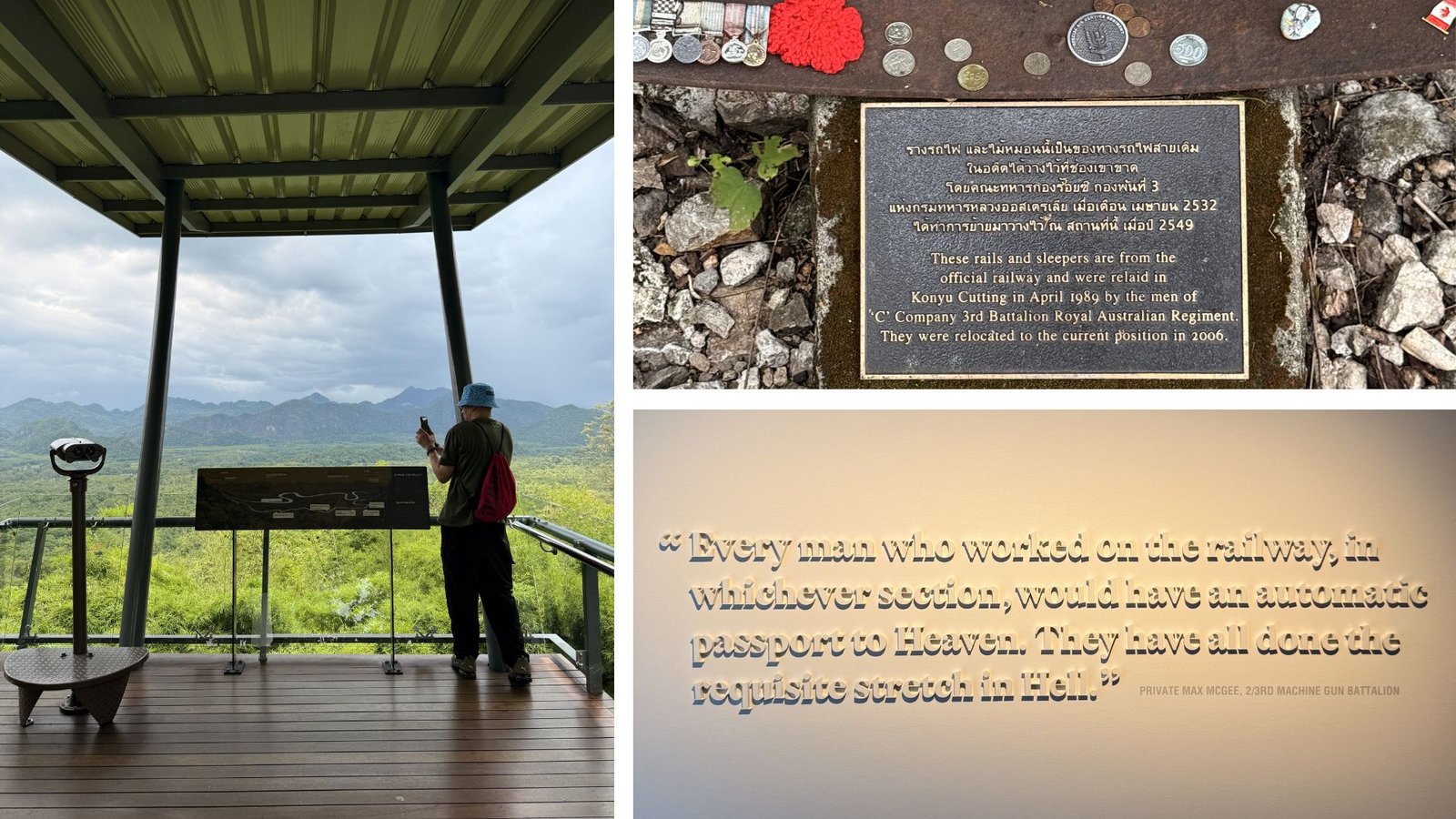
The trek itself isn’t particularly difficult. There are a few gentle slopes and some sections going up and down, but since this follows the old railway alignment, much of the route is relatively flat. The only slightly uncomfortable part is walking over loose rock and gravel, and also climbing up the flight of stairs in the last stretch.
Honestly, the walk itself isn’t particularly difficult physically, but emotionally, it can feel quite heavy.
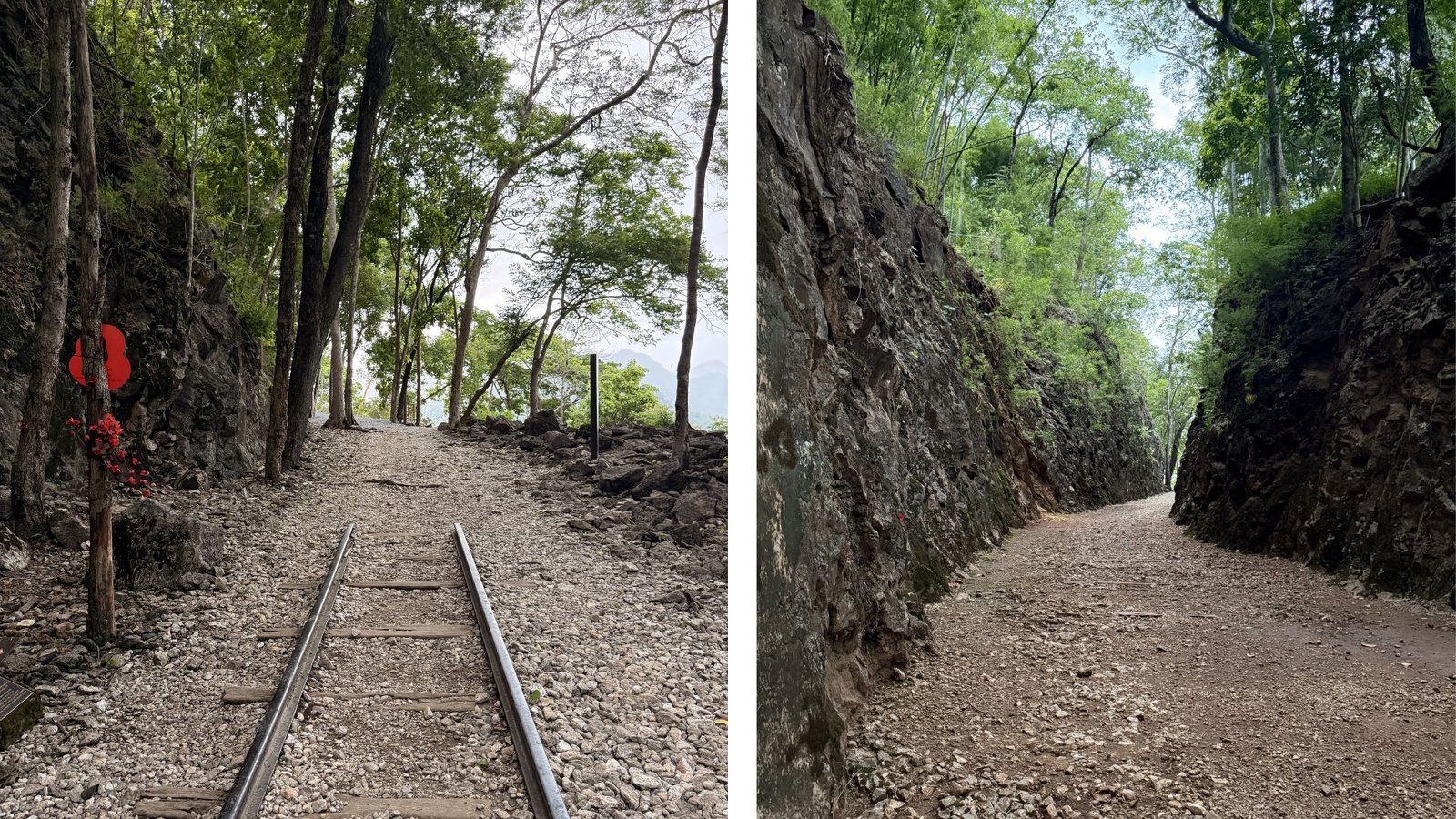
Today, this trail is serene, green, and extremely beautiful. But less than a century ago, this same path saw thousands of people working under impossible conditions. The scale is hard to comprehend. Standing there, surrounded by stillness, it was strange to think that a place that once held so much suffering, now feels almost untouched.
What the Death Railway Left Behind
When I first added the Death Railway to my Thailand itinerary, I thought I was signing up for a historical day trip. What I didn’t expect was to come back carrying so many thoughts.
This journey through Kanchanaburi ended up being one of those travel experiences that was partly somber, partly exciting, and deeply enriching in a way I hadn’t anticipated.
Walking through Hellfire Pass, standing at Konyu Cutting, reading stories inside the Death Railway Museum, and seeing the personal belongings of people who once lived through unimaginable circumstances made the history feel unexpectedly real. It is difficult not to feel something while walking down a trail that has once witnessed so much suffering.
And yet, there was also beauty.
The rivers flowed quietly, forests stretched endlessly, trains moved through valleys, and the surrounding landscape looked breathtaking. It felt almost impossible to reconcile the calm of the present with the stories of the past.
On the drive back to Bangkok, I found myself thinking less about the railway itself and more about people and how history shapes us. We learn about World War II through familiar narratives. Hitler. The Axis and Allied powers. The bombings of Hiroshima and Nagasaki. But somehow, I had never come across what happened here in Thailand, or the story of the thousands of prisoners of war and Asian labourers who lost their lives building this railway.
It made me wonder how many such stories quietly exist outside textbooks. And perhaps that is why I am increasingly drawn towards places like this. Places that are not just beautiful to look at, but meaningful to experience. Places that teach us something, challenge what we know, and quietly stay with us.
Because travel, at least for me, is not just about seeing. It is also about feeling, understanding, and carrying stories home.
FAQs About The Death Railway and Kanchanaburi
1. What is the Death Railway in Thailand?
The Death Railway, also known as the Thailand–Burma Railway or Burma–Siam Railway, was built during World War II by the Japanese military to connect Thailand with Burma (now Myanmar). It was constructed using forced labour, including Allied prisoners of war and Asian labourers (romusha), under extremely harsh conditions.
2. Where is the Death Railway located?
The most visited section of the railway is in Kanchanaburi Province, around 125 km west of Bangkok, making it one of the most popular day trips from the capital.
3. Can you still ride the Death Railway?
Yes. A surviving section of the original railway still operates today. Visitors can take the train from Kanchanaburi towards Nam Tok, crossing the Bridge on the River Kwai and passing through beautiful countryside.
4. Is the Bridge on the River Kwai the original bridge?
Yes, the bridge forms part of the historic railway route. While it has undergone repairs and reconstruction over the years, it remains one of the most important landmarks connected to the Death Railway.
5. How far is Kanchanaburi from Bangkok?
Kanchanaburi is approximately 125 km from Bangkok, and the drive usually takes around 2.5 to 3 hours.
6. Is a day trip to Kanchanaburi enough?
A day trip is enough to cover the main highlights, including the War Cemetery, Death Railway Museum, train ride, Bridge on the River Kwai, and Hellfire Pass. But if you enjoy slower travel, staying overnight lets you explore more of Kanchanaburi beyond its wartime history.
7. Is the Hellfire Pass hike difficult?
No, the trail is fairly manageable. There are some slopes and uneven gravel surfaces, but most visitors can comfortably complete it with good walking shoes and water.
8. Is Kanchanaburi worth visiting if you are not interested in history?
Absolutely. Kanchanaburi is not just about World War II history. It is also one of Thailand’s most scenic provinces with rivers, waterfalls, forests, caves, and slow travel experiences. You would find nice hotels in Kanchanaburi if you wish to stay longer.
9. What are the best things to do in Kanchanaburi besides the Death Railway?
If you have an extra day or two, there’s plenty more to explore:
- Visit Erawan National Park and hike to the famous seven-tier Erawan Waterfall
- Stay in one of Kanchanaburi’s floating river resorts
- Explore Sai Yok National Park for waterfalls and caves
- Visit Wat Tham Suea (Tiger Cave Temple) for panoramic views
- Visit Prasat Muang Singh Historical Park, one of Thailand’s lesser-known Khmer heritage sites
- Explore riverside cafés and slow down for a night in town
10. What is the best time to visit Kanchanaburi?
The cooler months from October to February are generally the most comfortable. If visiting Hellfire Pass, mornings are ideal as the walk can get warm later in the day.
Disclaimer: This post contains a few affiliate links. If you happen to click on any of them and make a purchase, I might earn a small commission at no extra cost to you. Just know that I truly appreciate your support if you choose to do so.
Tags:
Share:


About Me
I travel to collect stories, slowly and meaningfully, with an open heart. I wander a little farther for good food, linger longer to understand a place, and write so I can call it “work.” A slow traveller at heart, I believe in experiences over checklists, in moments that unfold at their own pace, and in connections that stay long after the journey ends.
An absolute foodie and die-hard mountain lover, I find my happiest moments in quiet Himalayan towns with a cup of lemon-honey-ginger tea in hand. Over the years, I’ve had the joy of exploring places across India and beyond, each trip teaching me something new about people, cultures, and myself. When I’m not lost in thought or coffee, you’ll find me exploring the world one destination at a time, always looking for places that make me feel something. I love to read and write (give me a book and I’ll love you all the more) and share honest insights, real photos, and thoughtful recommendations from my own travels, so you can experience every place a little deeper, a little slower, and with just the right touch of comfort.
 Pinterest
  Linkedin
  MuckRack
Exploring The World, One Place At a Time!